
Reading
'Stay alert and hold firmly to all you believe. Be mighty and full of courage. Let love and kindness be the motivation behind all that you do.'
1 Corinthians 16:13-14
At Brimscombe, we believe that reading opens the door to a lifetime of learning, imagination and discovery. We are passionate about developing confident, fluent readers who read widely, think deeply and find joy in books.
Through carefully chosen texts, high-quality teaching and a love of reading woven throughout school life, we support every child to build the skills, knowledge and vocabulary they need to become successful readers.
We want our children not only to learn to read, but to become readers who choose to read.
Curriculum
Our reading curriculum is designed to help every child become a confident, fluent and enthusiastic reader. In EYFS and Key Stage 1 (Reception, Year 1 and Year 2), we use Little Wandle Letters and Sounds to teach children the essential skills they need to read accurately and fluently. Children develop their phonic knowledge alongside regular opportunities to read books that match the sounds they have learnt, helping them to build confidence and experience success.
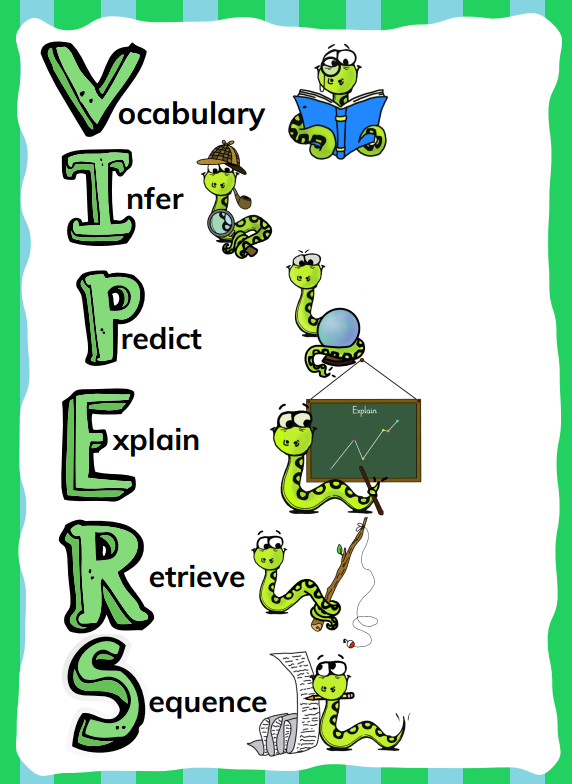
In Key Stage 2 (Year 3–6), we use VIPERS, developed by the Literacy Shed, to explicitly teach children the skills they need to understand and think deeply about what they read. Through a rich range of carefully chosen texts, children develop their vocabulary, make connections, retrieve information, explain their thinking, make inferences and learn to discuss and evaluate what they have read.
Teaching
As part of the Little Wandle programme, children have daily, carefully structured phonics lessons where they learn the sounds represented by letters and groups of letters, and practise blending these sounds together to read new words.
New learning is regularly revisited so that children can build on what they already know and remember it securely.
Alongside phonics, children read a book in school that is carefully matched to the sounds they have been taught. They read the book several times, developing their accuracy, fluency and expression before bringing it home to share with their families.
This approach means that children can experience the joy of reading while building the strong foundations they need to become independent readers.
As children become more fluent readers, the focus of teaching reading develops from learning how to read words to understanding, analysing and responding to what they read.
In Key Stage 2, the VIPERS approach is used to explicitly teach the different skills involved in reading comprehension. Through high-quality texts, teachers model how to think like a reader and children are given opportunities to practice and discuss their ideas.
They learn to retrieve information, explain the meaning of words and phrases, make inferences, predict what might happen next, summarise key information and consider the choices made by an author.
We revisit these skills regularly across a wide range of fiction, non-fiction and poetry so that children become increasingly independent, thoughtful and critical readers.
Achievement
In Reception and Key Stage 1, teachers closely monitor children's phonic knowledge and reading fluency through daily teaching, observation and regular assessment within the Little Wandle programme.
In Key Stage 2, teachers assess children's understanding of texts through classroom discussion, questioning and reading activities, alongside more formal assessments (NFER) at appropriate points throughout the year.
Assessment information is used to identify gaps or misconceptions and to adapt teaching and provide additional support where needed. Children who need extra support may receive targeted phonics, fluency or comprehension intervention, with their progress monitored carefully.