
Writing
'Stay alert and hold firmly to all you believe. Be mighty and full of courage. Let love and kindness be the motivation behind all that you do.'
1 Corinthians 16:13-14
At Brimscombe Primary School, we aim to develop confident, purposeful and skilled writers. Writing is carefully sequenced through high-quality texts, rich experiences and meaningful discussion, enabling pupils to build vocabulary, language structures and subject knowledge before writing independently. Children are guided through the writing process, including immersion, planning, drafting, revising and editing, with explicit teaching of grammar, punctuation and spelling woven throughout. We place a strong emphasis on audience and purpose, ensuring that pupils understand why they are writing and who they are writing for. Through regular opportunities to write across the curriculum, pupils develop the stamina, creativity and technical accuracy needed to communicate effectively and become successful writers for life.
Curriculum
Our writing curriculum is carefully designed to ensure that pupils write regularly and purposefully across a broad range of genres, audiences and contexts. From Year 1 to Year 6, children develop their skills through meaningful writing opportunities that are closely linked to learning across the wider curriculum, including history, geography, science, RE, DT and British Values. Pupils learn to inform, entertain, persuade and create poetry, applying their writing skills to authentic outcomes such as reports, biographies, narratives, explanations, balanced arguments, letters and newspaper articles.
The curriculum overview shows the progression and variety of writing outcomes across Key Stage 1 and Key Stage 2, with writing linked closely to foundation subjects and moving from simple reports, stories and instructions in KS1 to biographies, balanced arguments, formal letters and extended narratives in upper KS2.
Handwriting
 We use Letter-Join to develop fluent, consistent handwriting across the school. Children are taught correct letter formation from the outset, building towards a joined, legible style that supports writing stamina and presentation.
Letter-Join provides clear modelling, regular practice and progressive skill development, ensuring handwriting becomes automatic, so that children can focus on the content and quality of their writing.
Spelling
In Early Years and Key Stage 1, Little Wandle teaches spelling alongside the systematic teaching of phonics, helping children to understand the relationship between sounds and letters. As pupils learn new phonemes and graphemes, they are taught to apply this knowledge when spelling words, segmenting spoken words into individual sounds and selecting the correct letter patterns to represent them. Through daily practice, children develop increasing accuracy in spelling both decodable and common exception words, while regular revisiting and consolidation helps knowledge become secure. This approach ensures that spelling is not taught in isolation but as an integral part of learning to read and write, giving children the foundations they need to become fluent, confident writers.
In Key Stage 2, we use the Magic Spell programme to build upon the phonics and spelling foundations established through Little Wandle. Through regular, interactive lessons, children explore how words are formed and connected, enabling them to make informed spelling choices rather than relying solely on memorisation. Spelling knowledge is revisited and practised frequently to support long-term retention, while opportunities to apply new learning in independent writing help pupils become accurate, confident and increasingly sophisticated spellers. This approach supports both spelling fluency and vocabulary development, equipping pupils with the tools they need to communicate effectively in writing.
Teaching
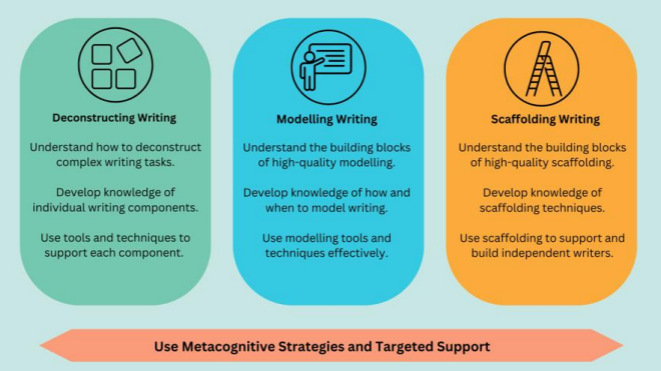
Writing is taught through Gloucestershire's Write Journey approach, enabling children to build knowledge, vocabulary and confidence before crafting and refining their own pieces. As pupils progress through the school, they encounter increasingly sophisticated writing challenges and independent writing opportunities, helping them to become confident, resilient and reflective writers who can communicate effectively for a range of purposes.
Achievement
Writing assessment at Brimscombe is rooted in our belief that confident writers need secure foundations. We assess pupils' development in handwriting, spelling, punctuation and sentence construction through a structured programme of baseline and termly assessments, alongside regular evaluation of independent writing. Children are assessed against clearly defined age-related expectations, allowing teachers to identify strengths and gaps and adapt teaching accordingly. By tracking pupils' progress carefully and using assessment to inform targeted support and intervention, we ensure that all children build the essential knowledge and skills required for success as writers. Our assessment approach provides a clear picture of progress over time and helps pupils develop increasing accuracy, fluency and independence in their writing.